
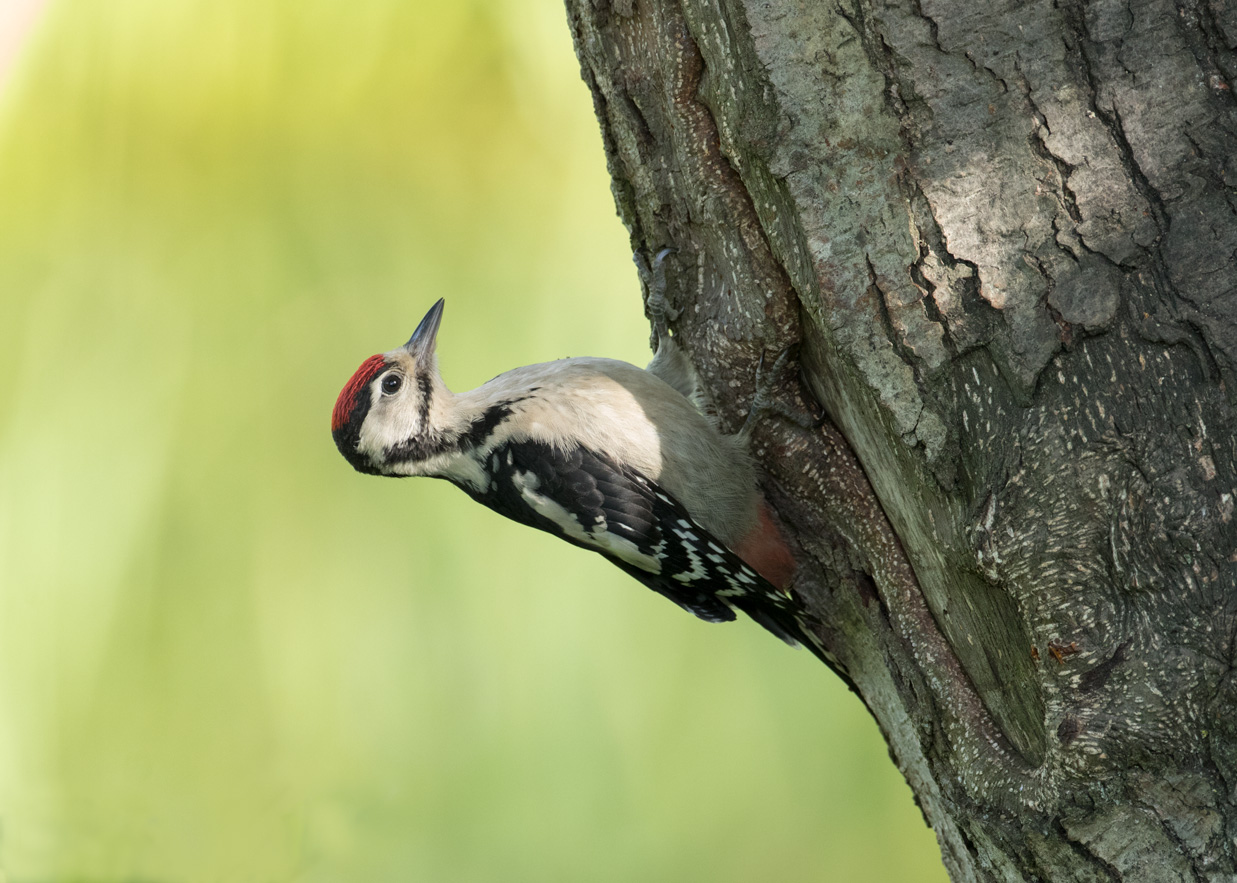
There are great spotted woodpeckers in Yorkshire, and they can be seen in woodland. They will visit bird feeders in Winter, and they particularly like fatty scraps from fish and chip shops.

Woodpeckers are specialists in climbing vertical tree trunks and excavating nest holes in them.
They fall within the family Picidae and the genus Dendrocopus. The great spotted woodpecker's Latin name is Dendrocopus major.

Collins Bird Guide shows the great spotted woodpecker present all year round in Britain.
It also lives further north, into Scandinavia, and further south in France, Italy and Spain. It has a vast range to the east of Britain, as far as Japan (Wikipedia).

Great spotted woodpeckers are 23-26cm long. They are the commonest type of woodpecker.
You can see them shinning up and down trees. To facilitate this, their feet are arranged in a zygodactyl way - two toes facing forward and two back - and their tail feathers are stiff so they can be propped against the tree trunk.
Woodpeckers' skulls are adapted to withstand hammering against hard wood, which they do to extract insects and to advertise their territory.

The easiest way to tell what sort of great spotted woodpecker you're looking at is to examine the crown.
Juveniles (main photo at the top of the page) have a red crown. Males (photo immediately above) have what Collins Bird Guide describes as a sugar lump-sized red patch on the hind crown.
Females have a black crown.

Great spotted woodpeckers eat insects and the eggs and chicks of other birds, as well as seeds. They wedge pine cones in bark crevices in order to extract the seeds.
When visiting bird tables and feeders, they are alert and cautious.
This is a very young woodpecker at High Batts in June 2022:
